The Complete Guide to Podcast Booking Services: How to Choose, What to Pay, and How to Measure ROI
Quick Answer: A podcast booking service researches, pitches, and secures podcast guest appearances on your behalf. The best services go beyond placement volume to match you with shows that reach your target audience, prepare you for high-impact conversations, and help you repurpose each appearance into revenue-generating assets. This guide is for founders, executives, authors, consultants, and B2B marketers who want podcast guesting to drive authority, pipeline, and measurable business outcomes—not just media exposure.
What Podcast Booking Services Do and Who They Are For
A podcast booking service manages the entire guest appearance lifecycle: identifying relevant shows, writing customized pitches, coordinating schedules, preparing you for interviews, and often repurposin
Show research and list building — identifying podcasts that reach your ideal audience based on topic relevance, listener demographics, and show quality
Outreach and pitch writing — crafting personalized pitches that align your expertise with each host's content needs
Scheduling and coordination — managing calendar logistics, time zones, and recording platform setup
Pre-interview prep — providing talking points, background on the host, and strategic messaging guidance
Post-appearance follow-up — coordinating thank-you notes, promotional assets, and episode sharing
Content repurposing — extracting clips, quotes, blog posts, social media assets, and sales enablement materials from each recording
This service model is designed for professionals who need podcast guesting to support specific business objectives: building authority in a technical domain, generating qualified leads, strengthening executive visibility, creating sales enablement content, or establishing trust before high-stakes decisions. It's a middle-of-funnel (MOFU) strategy, not a top-of-funnel awareness play.
The ideal clients are founders positioning themselves as category experts, executives building industry credibility, authors promoting books while demonstrating expertise, consultants establishing domain authority, and B2B marketers who need content that moves prospects from consideration to conversation.
If you're measuring success by download counts alone, podcast booking services are probably overkill. But if you're evaluating appearances based on pipeline influence, referral traffic, backlinks, speaking invitations, or sales conversations started, they become a strategic asset.
Why Podcast Guesting Still Matters in 2026
Podcast advertising revenue demonstrates continued growth and commercial viability. According to the IAB's U.S. Podcast Advertising Revenue Study, podcast ad revenue reached $1.9 billion in 2023, with projections approaching $2.6 billion by 2026. This growth is being driven by programmatic buying adoption, the expansion of video podcasting, and increased advertiser confidence in podcast audiences.
Video podcasting specifically has become a major distribution channel. Spotify reports that more than 250,000 video podcast shows are now available on its platform, with over 170 million users having watched a video podcast. Importantly, more than 70% of users consuming video podcasts watch them in the foreground, meaning they're actively engaged rather than multitasking—a significant advantage for guest experts who need to establish credibility through detailed explanations or product demonstrations.
Listener attitudes toward advertising and sponsored content remain favorable. Edison Research's Podcast Consumer 2025 study found that 88% of weekly podcast consumers agree that hearing ads is a fair price for free content, and 68% do not mind hearing ads on podcasts. This receptivity extends to expert-led content and host-read endorsements, which often perform better than traditional display or interruption advertising.
The broader creator economy is also expanding. IAB's 2025 Creator Economy Ad Spend & Strategy Report projects that U.S. creator ad spend will reach $37 billion in 2025, up from $13.9 billion in 2021 and $29.5 billion in 2024. Podcasts are a core component of this ecosystem, particularly for B2B audiences seeking in-depth, expert-driven content.
From an audience trust perspective, Ofcom's Media Nations 2025 report found that 50% of podcast listeners feel podcasts make them more informed, and 38% would be comfortable relying on podcasts as a primary information source. For B2B decision-makers, this means podcast appearances can influence purchasing decisions, vendor evaluation, and strategic planning.
Finally, measurement and targeting capabilities continue to improve. Triton Digital's April 2025 update introduced survey-based listener rankings and Demos+ audience profiles tied to demographic, socioeconomic, lifestyle, and purchase-intent segments. This means booking agencies can now target shows based on listener behavior and intent, not just download volume—making guest placements more strategically valuable.
The takeaway: podcast guesting works in 2026 because the channel is growing, audiences are engaged and receptive, video distribution is expanding reach, and targeting has improved enough to support demand generation and pipeline objectives.
The 3 Main Types of Podcast Booking Services
Not all podcast booking services operate the same way. Understanding the three main models will help you evaluate fit before you sign a contract.
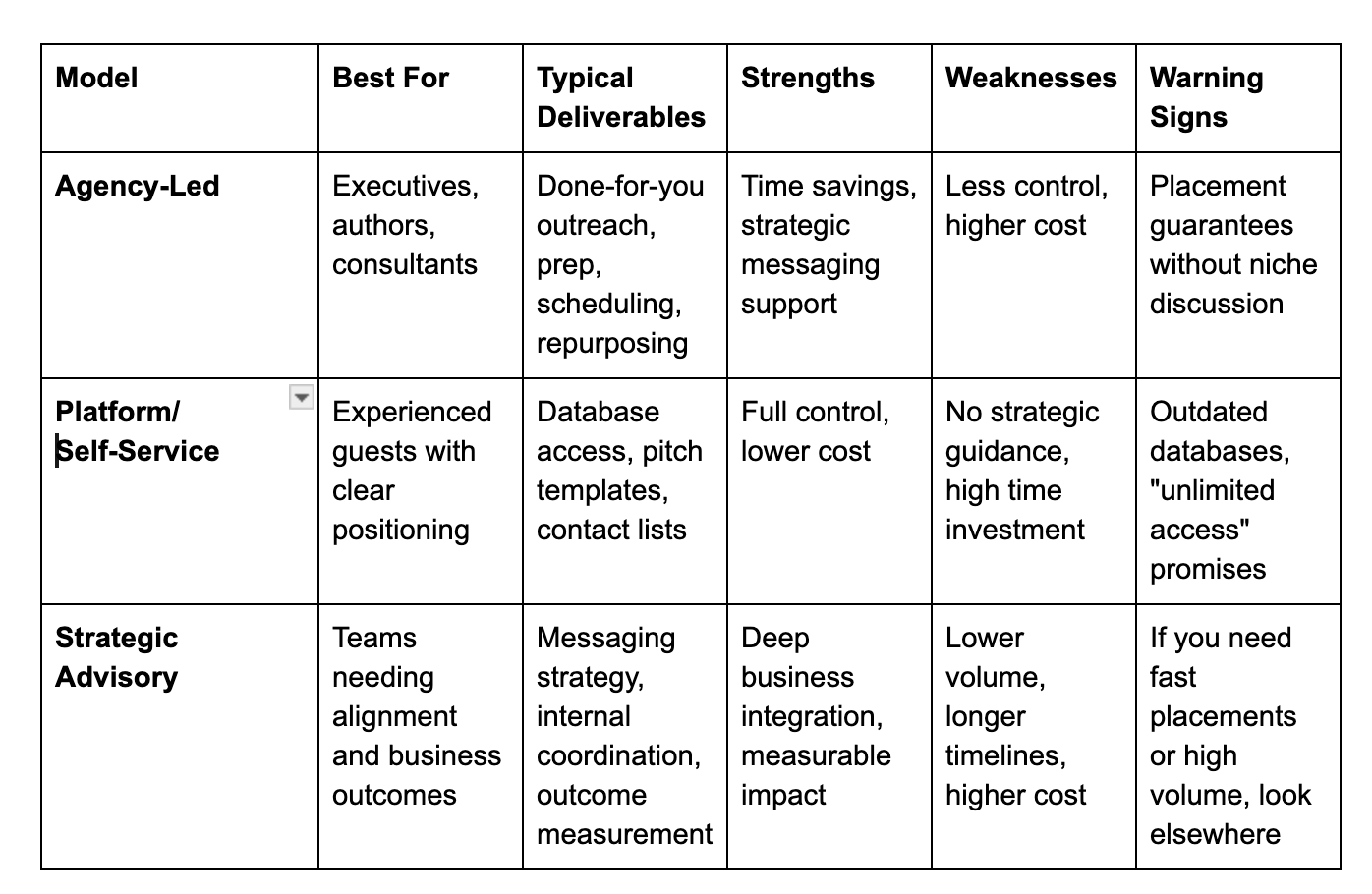
1. Agency-Led Booking Services
Best for: Executives, authors, and consultants who want done-for-you placement with strategic messaging support.
What's included: Full-service outreach, pitch customization, scheduling, prep calls, media training, and often post-interview repurposing. Agencies typically curate show lists based on your goals and handle all communication with hosts.
What's left out: You're usually not choosing specific shows yourself. The agency prioritizes fit based on audience alignment, not just your personal preferences. Some agencies also limit the number of bookings per month.
Biggest tradeoff: Higher cost and less control over which shows you appear on, but significantly better messaging alignment and time savings. You're paying for strategy, not just outreach volume.
Warning signs: Agencies that guarantee a fixed number of placements without discussing niche difficulty, or that pitch you to shows with no audience overlap. If they're leading with "we'll get you on 10 podcasts this month," ask which 10 and why those matter.
2. Platform or Self-Service Booking
Best for: High-volume guests who have clear messaging, media experience, and time to manage their own pitching and scheduling.
What's included: Access to a database of podcasts, sometimes with contact information and pitch templates. You handle the research, outreach, and follow-up yourself.
What's left out: Strategic guidance, pitch customization, prep support, and quality control. You're responsible for evaluating show fit, writing compelling pitches, and managing the entire relationship.
Biggest tradeoff: Lower cost and full control, but you're doing the work yourself. If you don't already have strong media skills and a clear positioning framework, the time investment can outweigh the savings.
Warning signs: Platforms that promise "unlimited podcast access" without explaining how they verify contact information or filter for show quality. Outdated databases lead to wasted pitches and low response rates.
3. Strategic Advisory or Hybrid Support
Best for: Companies that need podcast activity aligned to broader business objectives—executive positioning, stakeholder alignment, crisis communication, or coordinated thought leadership programs.
What's included: A combination of booking support, messaging strategy, internal alignment facilitation, and outcome measurement. This model treats podcast guesting as one component of a larger communication program, not a standalone tactic.
What's left out: High-volume placements. These services prioritize strategic fit and business impact over appearance volume. You'll do fewer interviews, but each one will be tightly aligned to your objectives.
Biggest tradeoff: Higher cost and longer timelines, but better integration with sales, product marketing, and executive communications. This model works best when podcast guesting needs to support a larger coordination problem.
Warning signs: If you're looking for fast placements or high volume, this isn't the right model. It's designed for teams that need podcast activity to move specific business metrics, not just generate awareness.
Service Model Comparison Table
How Much Podcast Booking Services Cost and What You Should Pay For
Pricing varies widely based on what's included, but here's a framework for evaluating cost against deliverables.
Pricing by Service Model
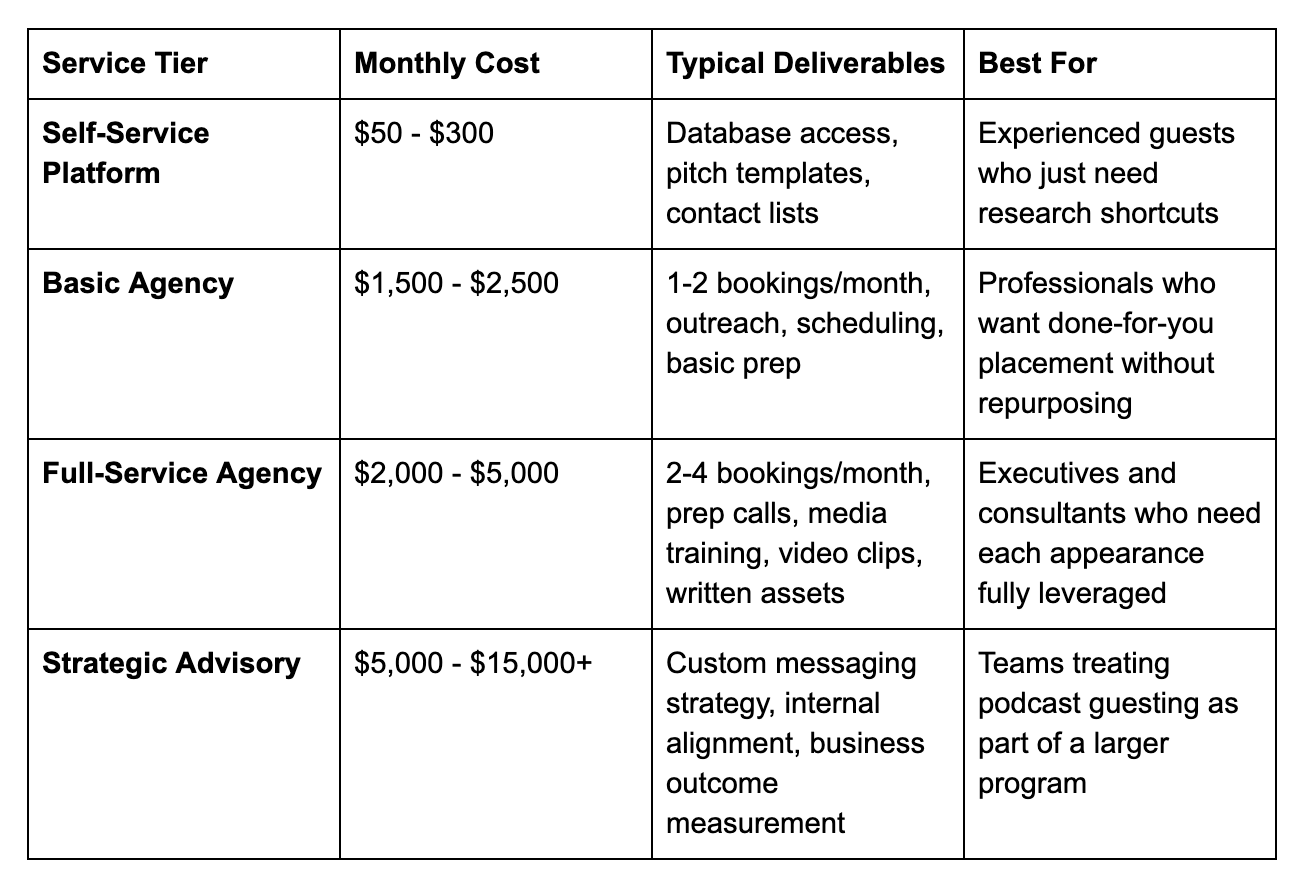
Self-service platforms typically charge $50-$300 per month for database access and pitch templates. You're paying for convenience and contact information, not strategic support. This works if you have media experience and just need to save time on research.
Agency-led booking ranges from $1,500 to $5,000+ per month, depending on niche difficulty, placement volume, prep support, and repurposing. According to Fame Connect's live pricing page, their $2,000/month plan includes 2 external bookings per month, 1 internal booking per quarter, 5 video clips per booking, and 4 written assets per booking. This is a useful benchmark: you're paying roughly $1,000 per external placement plus post-production support.
Strategic advisory or hybrid models typically start at $5,000 per month and can exceed $15,000 for enterprise clients. You're paying for business alignment, internal coordination, stakeholder messaging, and outcome measurement—not just bookings. This model makes sense when podcast activity needs to support executive positioning, product launches, or crisis response.
What Affects Pricing
Here's what drives cost variations:
Niche difficulty — highly technical, regulated, or niche industries (biotech, cybersecurity, financial services) require more research, more credibility-building in pitches, and often longer sales cycles with hosts. Expect to pay 30-50% more than general business categories.
Show quality expectations — if you're targeting top-tier shows (high download counts, established hosts, well-known brands), placement rates drop and outreach effort increases. Services that guarantee placements on high-authority shows charge premium rates because acceptance rates are low and competition is high.
Prep and repurposing — basic booking services just secure the placement. Full-service agencies that include media training, prep calls, clip extraction, and written assets charge 2-3x more, but you're also getting 10x more value from each appearance.
Placement guarantees — some agencies guarantee a minimum number of placements per month. This sounds attractive, but it often leads to lower-quality bookings. If the agency is prioritizing volume over fit, you'll appear on shows that don't reach your audience. The better approach is to ask about average acceptance rates, typical show profiles, and how they handle months where placements are delayed.
Pricing Comparison Table
Red Flags in Pricing
Be cautious if you see:
Guaranteed placement numbers without niche discussion — "We guarantee 10 bookings per month" is a warning sign unless they've already researched your field and confirmed show availability.
Pay-per-placement with no prep or repurposing — you'll get booked, but you won't be prepared, and you won't extract value from the appearance.
No visibility into what you're paying for — if the agency can't explain how outreach volume, pitch customization, and prep time map to your monthly fee, pricing is likely arbitrary. Conversely, agencies that can show you their targeting methodology—like Wonderfish's proprietary AI audience scoring—demonstrate they're using data, not guesswork, to match you with shows.
Front-loaded fees with vague deliverables — legitimate agencies bill monthly or quarterly and tie fees to specific outputs. If they're asking for a $10,000 upfront payment with no deliverable schedule, walk away.
How to Evaluate a Podcast Booking Service Before You Hire One
Here's a practical scorecard for vetting agencies on sales calls.
1. Niche Fit and Prior Bookings
Ask: "Have you worked with clients in my industry, and which shows have you placed them on?"
You want to see evidence that the agency understands your audience and has relationships with relevant hosts. If they say "we work with all industries," ask for case studies from your specific niche. Generic experience doesn't translate to niche credibility.
Also ask: "What's your acceptance rate for first-time clients in my field?" If they dodge this question or claim 100% acceptance, they're either inexperienced or lying. Real acceptance rates for cold outreach range from 10-30%, depending on the client's positioning and the agency's pitch quality.
2. Quality Control and Show Vetting
Ask: "How do you evaluate whether a show is worth pitching?"
The best agencies use a combination of audience demographics, download data, listener intent, host credibility, and content quality. Weak agencies prioritize volume and pitch to any show that accepts guests.
Red flag: If the agency can't explain their vetting process or says "we pitch to shows with over X downloads," they're using vanity metrics. A show with 500 highly targeted listeners is more valuable than a show with 10,000 general-interest listeners if you're selling enterprise software.
3. Transparency and Reporting
Ask: "What will I see in monthly reports, and how often will we communicate?"
You should receive regular updates showing:
Number of pitches sent
Response rates and acceptance rates
Confirmed bookings with show details
Interview prep materials
Post-interview assets delivered
Performance metrics (traffic, backlinks, engagement)
If the agency is vague about reporting or says "we'll send updates when something happens," that's a warning sign. The best services provide structured reports even when placements are slow, because transparency builds trust.
4. Media Training and Preparation
Ask: "What kind of prep do you provide before interviews?"
Basic services send a one-pager with host background and sample questions. Full-service agencies provide prep calls, strategic talking points, and media coaching for clients who need it.
If you're new to podcasting or representing a complex technical topic, media training is non-negotiable. A poorly prepared interview wastes the placement and can damage your credibility.
5. Content Repurposing
Ask: "What happens after the episode is published?"
This is where most booking services stop, and where the best ones create 10x value. Look for agencies that extract clips, write social posts, create email assets, pull quotes for sales enablement, and coordinate promotion with your team.
If the agency's answer is "we'll send you the episode link," you're paying for placement but leaving most of the value on the table.
6. Business Alignment
Ask: "How do you ensure podcast appearances support our business goals?"
Generic agencies will say "we get you in front of your audience." Strategic agencies will ask about your sales cycle, pipeline metrics, competitive positioning, and internal stakeholder priorities.
If the agency doesn't ask about your business objectives during the sales call, they're not equipped to align podcast activity to measurable outcomes.
For teams that need podcast guesting to support larger coordination challenges—executive messaging, stakeholder alignment, or cross-functional thought leadership—consider working with a strategic partner like Wonderfish. Unlike booking-only vendors, this model treats podcast appearances as one component of a larger communication program, ensuring each placement supports specific business objectives and integrates with sales, product marketing, and executive communications.
Pre-Hire Checklist
Before signing a contract, confirm:
The agency has placed clients in your niche and can name specific shows
They explain their vetting process using audience quality, not just download counts
You'll receive structured monthly reports with clear metrics
Prep support is included, not an add-on
Post-interview repurposing is part of the package
They ask about your business goals, not just your bio and talking points
Pricing is transparent and tied to specific deliverables
Contract terms allow you to pause or cancel if placements don't meet expectations
Common Red Flags
Walk away if you encounter:
Guaranteed placement numbers without discussing niche difficulty — this usually leads to low-quality bookings
No examples of past client placements — either they're new and unproven, or they're hiding poor results
Vague answers about prep and repurposing — if they can't explain what you'll receive, you won't receive much
High-pressure sales tactics or limited-time offers — legitimate agencies don't need to rush you
No references or testimonials from clients in your industry — social proof matters, especially in niche markets
How to Measure ROI from Podcast Bookings
Podcast ROI goes far beyond download counts. Here's how to connect appearances to business outcomes.
Pipeline Influence
Track how many sales conversations, demos, or proposals follow podcast appearances. Use UTM parameters on your podcast bio links and monitor referral traffic in your CRM. Tag contacts who mention hearing you on a podcast and measure their progression through your funnel.
Ask your sales team to include "How did you hear about us?" in discovery calls and log podcast mentions. Over time, you'll see patterns: which shows generate qualified leads, which topics resonate with buyers, and which industries respond best.
For B2B companies, pipeline influence is the most important metric. If podcast guesting is generating 3-5 qualified conversations per quarter, it's working—even if download counts are modest.
Referral Traffic and Conversion
Use Google Analytics or your website analytics platform to track traffic from podcast show notes, episode embeds, and social shares. Set up goals for newsletter signups, content downloads, or demo requests that originate from podcast referrals.
Compare conversion rates between podcast traffic and other channels. Podcast listeners often convert at higher rates than cold traffic because they've already spent 30-60 minutes hearing you explain your expertise.
Backlinks and SEO Value
Every podcast appearance should generate at least one backlink from the show's website. Track these using Ahrefs, Moz, or SEMrush. Quality backlinks improve your domain authority, which supports organic search performance across all your content.
If you're appearing on 10-15 podcasts per year, you should accumulate 10-15 high-quality backlinks—worth thousands of dollars in SEO value if purchased through traditional link-building services.
Content Reuse and Sales Enablement
Measure how often your team repurposes podcast clips, quotes, and episodes in:
Sales presentations and pitch decks
Email nurture sequences
Social media content
Website case studies and testimonials
Internal training and onboarding materials
Each appearance should generate 5-10 derivative assets. If you're doing 2 podcasts per month, that's 120 reusable assets per year—significantly more valuable than 24 one-time placements.
Speaker Invitations and Media Opportunities
Track how many conference speaking invitations, webinar opportunities, or media requests you receive after podcast appearances. Hosts, listeners, and event organizers often reach out to guests they discover through podcasts.
If you're targeting speaking engagements as part of your authority-building strategy, podcast guesting is one of the most efficient lead sources.
Brand Search Volume and Direct Traffic
Monitor Google Search Console for changes in branded search volume. After consistent podcast appearances, you should see an increase in people searching for your name or company directly.
Direct website traffic (users typing your URL directly into their browser) should also increase as awareness grows.
Simple ROI Framework
Here's a basic formula for evaluating whether podcast guesting justifies the spend:
ROI = (Pipeline Value + Content Value + SEO Value) - (Service Cost + Time Investment)
Example calculation:
3 podcasts per month at $2,000/month service cost = $24,000/year
5 hours per month of your time at $300/hour = $18,000/year
Total cost: $42,000/year
Value generated:
8 new sales opportunities with $50,000 average deal size and 25% close rate = $100,000 in closed revenue
36 podcast episodes repurposed into 180 social posts, 36 blog summaries, and 12 video clips = $15,000 in content creation value
36 backlinks with average $200 SEO value each = $7,200
Total value: $122,200/year
Net ROI: $80,200 or 191% return
This framework is conservative. It doesn't include brand awareness, speaking invitations, media coverage, or long-term compounding from SEO and content reuse.
This ROI model tracks with real client outcomes. Wonderfish reports that clients average 5-10 qualified leads per podcast appearance, which at typical B2B close rates (20-30%) translates to 1-3 new customers per interview. For businesses with customer lifetime values in the $10,000-$50,000 range, a single strategic podcast placement can generate $10,000-$150,000 in revenue.
The key is to define what success looks like before you start, then track those metrics consistently. If you're not measuring, you can't optimize.
For teams that need podcast activity aligned to measurable business outcomes—not just media activity—Wonderfish offers a strategic approach. By treating podcast guesting as part of a coordinated communication program, you ensure appearances support pipeline goals, executive positioning, and cross-functional priorities. This model works best when you need podcast ROI tracked at the business level, not just the marketing level.
How to Make Every Appearance More Valuable After the Booking Is Secured
Getting booked is only the first step. Here's how to extract maximum value from each placement.
Pre-Interview Preparation
Before recording, align on three things: audience expectations, strategic talking points, and promotional plans.
Audience expectations — ask the host: Who listens to this show? What problems are they trying to solve? What level of technical detail do they expect? This ensures you tailor your language and examples to the right sophistication level.
Strategic talking points — identify 3-5 key messages you want to communicate. These should connect your expertise to your business objectives. For example, if you're a SaaS founder, your talking points might emphasize methodology over product features, so you demonstrate expertise without sounding sales-focused.
Promotional plans — clarify how both you and the host will promote the episode. Will you share clips? Tag each other on social? Feature the episode on your website? Coordinating promotion doubles reach.
If the podcast booking service doesn't provide prep support, create your own prep document that includes host background, typical question themes, and your strategic messaging framework.
During the Interview
Focus on teaching, not pitching. The best podcast guests answer questions with frameworks, examples, and actionable insights—not product descriptions.
Use the "because" technique: when making a claim, follow it with "because" and a supporting reason or example. This makes your points more memorable and credible.
Reference specific experiences, not generalities. "When we redesigned our onboarding flow, activation increased 40%" is stronger than "Onboarding optimization is important."
End strong. Hosts usually ask "Where can people find you?" or "What should listeners do next?" Have a clear, specific call to action ready. Instead of "Check out our website," say "If you're struggling with [specific problem], we published a guide at [specific URL] that walks through [specific solution]."
Post-Interview Asset Extraction
As soon as the episode is published, extract multiple content formats:
Video clips — create 5-10 short clips (30-90 seconds each) that isolate your best insights. Use these on LinkedIn, YouTube Shorts, Instagram Reels, and as website embeds
Quote graphics — pull 3-5 quotable moments and turn them into designed social graphics. These work well on LinkedIn, Twitter, and in email signatures
Blog summaries — write a 500-800 word blog post summarizing the episode's key points. Link to the full episode and include additional resources. This improves SEO and gives readers who prefer text a way to engage.
Email assets — include episode clips, quotes, or summaries in your newsletter or nurture sequences. Podcast content adds credibility and variety to email campaigns.
Sales enablement — give your sales team clips, quotes, or episode timestamps they can share with prospects who ask about your methodology, case studies, or expertise. A 2-minute clip explaining your approach is often more effective than a PDF.
Social Distribution
Coordinate promotion with the host. Typical timeline:
Pre-launch (1 week before) — the host announces upcoming guests; share their announcement and add your own teaser
Launch day — both you and the host share the episode with custom messages for your respective audiences
Week 1 — share 2-3 video clips with key insights; tag the host and engage with comments
Week 2-4 — repurpose content into blog posts, quote graphics, and email mentions
Ongoing — feature the episode on your website, include it in your bio, and reference it in sales conversations
Don't just share a link once. A single podcast episode should generate 10-20 social posts over the first month.
Website Integration
Create a dedicated "Media" or "Podcast Appearances" page on your website that lists every episode with:
Show name and host
Episode title and description
Embedded player or video
Key topics covered
Relevant resources or follow-up content
This page serves as social proof, improves SEO, and gives prospects an easy way to evaluate your expertise.
Long-Term Content Reuse
After 6-12 months of consistent podcast appearances, look for patterns:
Which topics generate the most engagement?
Which frameworks or stories resonate best?
Which types of shows drive the most pipeline?
Use these insights to refine your positioning, create long-form content (whitepapers, courses, books), and optimize future podcast placements.
Some of your best blog posts, LinkedIn articles, and sales assets will come from insights you first explained on podcasts. Treat each episode as raw material for a larger content engine.
FAQ
What does a podcast booking service do?
A podcast booking service researches relevant shows, writes customized pitches, secures guest placements, coordinates scheduling, and often provides interview preparation and post-appearance content repurposing. The best services align placements with your business objectives, ensuring you appear on shows that reach your target audience and support measurable outcomes like pipeline generation, executive visibility, or sales enablement.
How much do podcast booking services cost?
Pricing ranges from $50-$300/month for self-service platforms to $1,500-$5,000+/month for full-service agency support. Strategic advisory services typically start at $5,000/month. Cost depends on niche difficulty, placement volume, prep support, repurposing deliverables, and whether the service guarantees placements. A useful benchmark: expect to pay $1,000-$2,500 per high-quality placement when prep and repurposing are included.
How long does it take to get booked on podcasts?
With a professional booking service, expect your first confirmed placement within 30-45 days. Some services report first opportunities within 2-3 weeks. Timelines depend on your niche, host responsiveness, and seasonal booking patterns. By month two, you should have 1-3 interviews scheduled. If you're not seeing confirmed bookings by day 60, either the agency's targeting is off or your positioning needs adjustment.
Are podcast booking guarantees real?
Yes, and they can be valuable when paired with quality targeting. The best agencies guarantee a minimum number of placements per month because consistency drives the compounding effect that makes podcast guesting work—regular appearances build momentum, expand your network effect, and create multiple touchpoints with your audience. The key distinction is whether the guarantee is backed by strategic show selection or just high-volume pitching to any show that accepts guests. Ask: "How do you ensure the guaranteed placements reach my target audience?" and "What's your process for vetting show quality?" A guarantee means nothing if the shows don't align with your business objectives, but when combined with audience scoring and strategic targeting, guaranteed monthly placements create the consistency needed for measurable growth.
What should I ask before hiring a podcast booking agency?
Ask about niche experience, show vetting criteria, acceptance rates, prep support, repurposing deliverables, reporting structure, and business alignment. Specifically: "Have you placed clients in my industry?" "How do you evaluate show quality?" "What prep do you provide before interviews?" "What happens after the episode is published?" "How do you measure success?" If the agency can't answer these clearly, keep looking.
Is podcast guesting worth it for B2B lead generation?
Yes, when done strategically. Podcast listeners are highly engaged, often consuming 30-60 minutes of your content in a single session—far more exposure than a blog post or social media ad. The key is targeting shows that reach your ideal customer profile, preparing strategic talking points, and repurposing each appearance into multiple assets. Track pipeline influence, referral traffic, backlinks, and content reuse. For most B2B companies, 10-15 high-quality podcast appearances per year generate measurable pipeline and significant content ROI.
Final Thought: Podcast booking services are only valuable when they connect placements to business outcomes. The best services don't just get you booked—they ensure you appear on the right shows, deliver high-impact interviews, and turn every appearance into revenue-generating assets. Whether you choose an agency-led model, a self-service platform, or a strategic partner like Wonderfish, the framework is the same: target quality over volume, prepare strategically, measure what matters, and repurpose relentlessly.